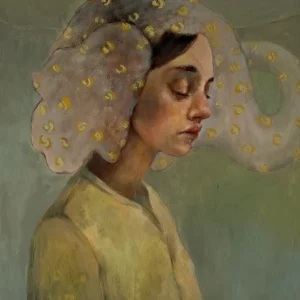


Beskrivning
Digital
70 x 100 cm
Do You Believe in Angels?
As someone who has believed in angels and experienced their presence in my life, I invite you to explore this topic with me.
Read on to discover my unique perspective, which resonates deeply with the themes of angels and fairies and may offer a new way of looking at these mystical beings.
”My Angel
She walked this earth with laughter, light,
A wisp of fire, burning bright.
The painters soul, a poets grace,
A rebel heart, a smiling face.
No wings adorned her slender frame,
No halo shone, no holy name.
Yet all who met her saw the gleam,
The glow of stars within her dream.
Her hands could shape the light and shade,
Turn sorrow into art she made.
She danced through life with fearless ease,
A storm, a whisper, a summer breeze.
She lied like angels sometimes do,
To guard, to spare, to weave what’s true.
Not seeking praise, nor seeking fame,
Just playing life’s imperfect game.
Her love was fierce, her joy untamed,
her kindness deep, though never claimed.
She left behind a trail so bright,
A path of wonder, art, and light.
Then fate turned cruel, as fate can be,
Her mind was a ship lost out at sea.
The storm rolled in, the colours blurred,
her laughter dimmed, her voice unheard.
Yet even as the dusk drew near,
Her angels soul stayed bright and clear.
And when she left, she did not fall
She rose beyond the earthly wall.
Now, on a star, she waits in time,
Where light is soft, and bells still chime.
For those who loved her, she remains
A gentle whisper in the autumn rains.
Not lost, not gone, but absent and free to roam,
An angel who has found her eternal home.
Malmö, February 2025
Angels and FairiesTwo Worlds of Mystery and Magic
Yet, they exist all around us, at least in part, in human form. For centuries, angels and fairies have fascinated people worldwide. Both represent something supernatural beyond our physical world, yet they differ significantly in their roles, origins, and symbolism.
AngelsMessengers and Guardians
Angels appear in many religions and mythologies but are best known from the Abrahamic tradition, where they serve as God’s messengers and protectors of humanity. They are often depicted as beings of light with great wings and an ethereal presence. According to tradition, angels do not possess free will like humans; instead, they are entirely devoted to carrying out the divine will.
In art and literature, angels are often portrayed as majestic and celestial. Still, there are more complex stories, such as fallen angels like Lucifer or more personal guardian angels.
FairiesEnchanting spirits of Nature
Fairies belong more to Nordic and Celtic folklore. They are tied to nature and the forests and are often described as small, beautiful, and delicate beings with supernatural powers. In Swedish folklore, fairies were associated with the mist veils that danced over meadows at dawn and dusk. They could be both helpful and deceptive; stepping into a fairy ring could mean being enchanted or lost in another world.
In Irish and Scottish traditions, people speak of the fair folk or sidhe, fairy-like beings living in a parallel reality who are not always friendly towards humans. These creatures possess a strong sense of pride and may seek revenge if insulted.
Where Worlds Meet
Angels and fairies represent different realmsthe heavenly and the earthly. Yet, in some stories, these worlds intersect, with fairies assuming a more spiritual role and angels adopting a more mythical or folkloric character. This intersection invites us to ponder the interconnectedness of our world and the spiritual realm.
In modern culture, both angels and fairies have been adapted and transformed. In fantasy and popular culture, fairies appear as powerful and independent beings, while angels are frequently depicted in a more human form. Both symbolise something beyond the ordinary, magical and enchanting. Angels are regarded as guides and protectors, whereas fairies, with their allure, entice us to explore the beauty and dangers of the hidden world.
So, what do you think? Do angels and fairies existand if they do, are they friends or foes? I have been to an angel, so I know they exist. In hindsight, I have realised that angels, too, have their weaknesses. Like all of us, they experience good and bad days, strengths and flaws. My angel has departed from the Earth and resides on a star, waiting in eternity for all who loved herand there were many. She had no wings, for angels do not fly but tread as we do, step by step, grappling with the same burdens. She had two angelic children who, thanks to her, grew into truly good people, each an angel in their way. And a little cherub who never got to be born but went straight to its star.
My angel was born an angel, and that is how I came to know her. An artistic angel, tall and slender, beautiful and funny, wonderfully eccentriceverything about her was good, even the less admirable aspects. She was a bit careless, but that added to her charm most of the time. When it mattered, she was both skilled and brave. My angel could tell a lie, too, for she did not wish to hurt with the truth like many others; thus, an alternative truth often suited the moment better, at least for her. Neither she nor those who tell such lies intend harm; it is simply in their nature. She never lied to appear better or to elevate her status; she remained the same angel throughout her life, and that is how we remember her. Like the angels in the Bible, she spread light wherever she went. However, that had nothing to do with religion, for though she was an angel, she was not religious.
My angel’s final years were unjust, but she never believed in fairness. Still, injustice often befalls those who deserve it the least. She first became a forgetful angel and then increasingly confusedshe had Alzheimer’s, a disease that does not spare even angels. It is an especially cruel affliction, stripping away the finest parts of a person, the angel we once knew. Yet, she must have had a guardian angel who ensured she departed with dignity. Our angel passed away peacefully in her own home, in her favourite chair, spared from the final degrading years of total loss of self. Thank you, kind angel, for that mercy.
What remains are memories shared only in thought, never truly exchangeable. These personal memories, sweet almonds for the most part, filled with laughter, love, and life, alongside some bitter almonds, are the essence of our angel’s legacy. They require two people to exist and rarely entertain anyone else.
My angel adored theatre, opera, books, and film. And celebrationfor she had a unique way of turning life into festivity, cooking meals worthy of an angels table.
Angels: Do They Exist? And Those Who Certainly Did
A film my angel adored, despite its lack of Oscar nominations, was Änglar, finns dom?translated as Do You Believe in Angels? or Love Matesa romantic comedy from 1961, directed by Lars-Magnus Lindgren. The film featured Jarl Kulle as the charming and worldly doctor Stellan and Christina Schollin as the innocent yet idealistic teacher Lillemor. My angel found Kulle handsomeand he indeed was. Meanwhile, Christina Schollin, modestly dressed and captured in soft backlit shots, certainly captivated the male audience.
The films title, Love Mates, reflects Lillemors naïve but heartfelt belief in love and the inherent goodness of people. This belief parallels the innocent and idealistic nature of angels in folklore. She encounters the more cynical and experienced Stellan, resulting in a romantic and humorous narrative where their conflicting worldviews are tested against one another, much like the tension between the naive and the cynical in folklore.
The film achieved considerable success and has since become a Swedish classic, mainly due to the electric chemistry between Kulle and Schollin and its light-hearted and warm tone. It is a prime example of Swedish romantic comedies from the 1960s, a period noted for exploring love and human relationships amidst a shifting society.
Far From Angelic Beings
In another aspect of folklore, one discovers creatures far removed from celestial guidanceentities that do not lead souls to the light but instead lure them into mist-covered lands, down into dark waters, or onto winding forest paths from which there is no return. These beings were often beautiful and seductive, yet they possessed a perilous allure that demanded caution. They were not guardian angels but trials imposed upon humanitytrials that seldom ended favourably for those who fell victim to their enchantments.
ElvesThe Dance of Beauty and Peril
Elves danced at dawn and dusk, ethereal figures draped in flowing white veils, yet those who stepped into their rings risked becoming ensnared by their spell. A moment within the elves dance could signify that a hundred years had passed in the human world. Their song was as sweet as it was deceptive, and those who listened too long could lose themselves entirely. In some tales, elves were benevolent, but in others, they stole away children or lured men to their doom.
The SkogsråThe Deceptive Woodland Nymph
No creature possessed a more dual nature than the Woodland Nymph, the mesmerising ruler of the deep woods. She appeared as an incomparably beautiful woman from the front, yet those who glimpsed her back saw it was hollow, like a rotting tree. She could seduce hunters and foresters, making them forget time and place, but her love was treacherousthose who fell for her often became lost souls, unable to leave the forest forever.
The Nixs DaughtersThe Waters Dangerous Lovers
Similar to elves, the daughters of the Nix were alluring yet merciless. They emerged by rivers and lakes, singing and laughing, their hair floating upon the water like silver threads in the moonlight. However, those drawn to them received only a kiss before sinking into the depths, never to return. Their father, the Nix, was a master of temptation. His violin melody was so enchanting that it lured both women and men to throw themselves into the water, yearning for something they could never attain.
Taken by the MountainOr Lost Forever
A common theme runs through the tales of these creaturesthose who encountered them and allowed themselves to be tempted vanished. Sometimes, physically, they ventured into the woods, the water, or the mountains, but other times only in their minds. The men who returned from the Woodland Nymph came back as empty shells, lost and incapable of loving a human woman again. Those who had listened too long to the Nixs song sat by the riverbank, gazing endlessly over the water, longing for something just out of reach.
Angels belonged in the heavens, yet these beings dwelled among usin the forests, streams, and mist. They were not a path to paradise but a door to the unknown, to something beyond human control. Beautiful? Yes. Enchanting? Certainly. But it is always dangerous, especially for weak-willed men. Women, meanwhile, must stay far away from the lustful Nix, who is just as treacherous.
But that is a story for another time.