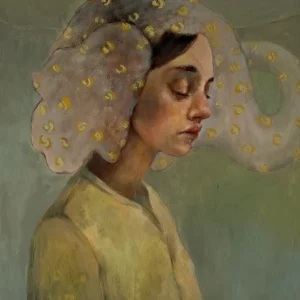


Beskrivning
Digital
70 x 100 cm
Día de los Muertos
Día de los Muertos, Through the Mirror, Into the Stones
The painting with the mirror, a haunting melody in my mind, revealed its truths in every detail. Fridas work, always rich with layers of meaning, reached a new level of profundity in this piece. The broken reflections, the brilliant colours of the stones, and Dorothy Hale’s watchful presence spoke to something more profound, more universal, resonating with truths we all can relate to.
Each stone in Señor Xolotls necklace told a story: the green malachite of transformation, the fiery carnelian of passion, the regal lapis lazuli of wisdom, the gentle rose quartz of love, and the bold garnet of resilience. These stones, with their unique properties and symbolic meanings, formed a constellation of meaning. They inspired us with their transformative power and bound Frida and Dorothy across time and space, reflecting the enduring nature of their connection.
The mirror in the painting was not just a reflectionit was a portal, a threshold between the visible and the hidden. It showed what was visible and hidden: truths, sorrows, and the bond between two souls transcending the veil of mortality. Fridas Mourning Blue dress, her symbolic roses, and the eternal flame of the candles whispered of lifes fragility and the need to cherish its fleeting beauty.
As Frida prepared for her next acta performance as a female Hamlet, a role as multifaceted as the stones in her paintingI realised the painting itself was a kind of performancea dialogue between past and present, between memory and creation, and we, the viewers, are an integral part of this dialogue, between what is lost and what remains.
The mirror held it all: the weight of sorrow, the spark of life, and the eternal connection between Frida and Dorothy. Its cracked surface asked us to see ourselvesnot as we wish to be, but as we are. Just as the stones in the painting reflect different aspects of life, the mirror reflects the truth, unfiltered and unadorned.
To the mirror, the stones, and the truths they reveal. Salud!
Will you join their dreams? Please read on.
Mirror, Mirror on the Wall
Mirror, mirror on the wall,
Tell me what the world recalls.
A truth untamed, a face revealed,
A life of cracks, yet beauty sealed.
Emerald green, the malachite hue,
A healers touch, a soul renewed.
In you, I see the battles fought,
The art, the pain, the lessons taught.
Carnelian burns in fiery light,
A passion fierce, both day and night.
Its pulse reminds of love and fight,
Of dreams pursued through endless plight.
Deepest blue, the lapis stone,
A thinkers gift, a mind alone.
Wisdom, sharp and bold, takes flight,
Through brush and words, through wrong and right.
Blush of rose, a quartz so tender,
Holds the love we fail to render.
Soft and fleeting, yet it stays,
A balm for wounds of darker days.
And garnet red, a warriors flame,
A steadfast heart, a timeless name.
Strength to weather every storm,
A spark of life in endless form.
Mirror, mirror, you show it all
The rise, the fall, the endless call.
A world of colour, love, and pain,
Each hue a chapter, each loss a gain.
Yet, as I gaze, I see me clear,
Not just the cracks but what I revere.
The stones reflect whats always true,
The world within, both old and new.
So tell me not whats fair or best,
But show the soul thats stood the test.
Mirror, mirror, on the wall,
Reveal the beauty in it all.
Malmö January 2025
Día de los Muertos
Me: Frida, one painting from your retrospective exhibition has captivated me more than any otherthe one with the mirror. You know the one I mean. Mirror, mirror on the wall, tell me what the world is etc., etc. It feels like your version of that fairy-tale queens obsession, but far more profound.
Frida: She smiled knowingly, swirling her signature Frida-Colada in her hand, a drink she created to reflect her vibrant personality and love for tropical flavours. Ah, yes, the mirror. I see youve been caught in its reflection, too. But tell me, what did you see in it? Did it show you what was thereor what was missing?
Me: Thats the thing, Frida. Unlike the funny mirrors at Tivoli Gardens in Copenhagen, which distort and flatter, your mirror doesn’t lie. Even those mirrors, with their wavy surfaces and exaggerated reflections, cant turn a good person bad or make a cruel person kind. They can only make us laugh or cringe at whats already there. Your mirror, though It doesnt just reflect faces. It reflects truths.
Frida: Her expression grew serious, and she leaned forward slightly, her floral crown catching the golden light of the setting sun. Youve captured it perfectly. That mirror doesnt distort, and it doesnt comfort. It shows the world as it iswhat exists and what doesnt. Thats why its so unsettling. Mirrors are supposed to be tools of vanity, arent they? But my mirror it has no patience for vanity.
Me: I can only imagine the debates among art historians after seeing it. They must be spinning themselves in circles, trying to dissect every detail. And to think this piece, like so many others, was hidden away for decades after you left the Earth in 1954.
Frida: She laughed softly, a sound tinged with irony. Oh, let them debate. Theyll say its about identity, politics, or mortality. And maybe it isall of that and more. But the truth is simpler: I painted that mirror to see myself. Not the version of me that Diego adored, the version the world pitied, or even the version I tried to show to myself. Just me. And thats what the mirror showed.
Me: But it wasnt just you in the mirror. The world was there tooharsh, unfiltered. I remember standing before that painting, feeling like it wasnt just you looking back, but everything you had seen and endured.
Frida: She nodded, sipping her drink thoughtfully. Youre right. The mirror shows the weight of what we carryand what weve lost. It doesnt spare anyone, least of all me. But isnt that what art should do? Hold up a mirror to the world, even when the world would rather look away. It’s a powerful tool that can enlighten and inspire us all.
Me: I wonder what people saw in that painting when it was unveiled. Indeed, there were tears. Perhaps even laughter, the nervous kind that escapes when confronted with too much truth at once.
Frida: There was all of that, she said, her voice softening. But mostly, there was silence. The silence hanging heavy, like a fog, when people realise theyre staring at themselvesat the parts they hide, the parts they wish they could forget. She paused, a wistful smile playing on her lips. And thats the beauty of the mirror. It doesnt let us forget.
Me: Speaking of forgetting how did you keep these paintings hidden for so long? The world missed out on so much. The mystery of concealment only adds to their allure, leaving us all intrigued and eager to learn more.
Frida: She tilted her head, her earrings catching the light. Perhaps it was for the best. I wasnt ready to share all of me then. And maybe the world wasnt ready to see it. But now now the timing feels right. Dont you agree?
Me: I raised my glass of Frida-Colada in a toast. To timing, to truth, and to the mirror that refuses to lie.
Frida: She clinked her glass against mine, her eyes shimmering with mischief and wisdom. Salud, my friend. And may we always have the courage to face what the mirror shows us.
Me: ”Frida, how did your painting with the mirror come about? Its haunting, yet so captivating.”
Frida: She set down her Frida-Colada, its warm sunset hues reflecting her skin, and sighed deeply. ”It all began with a photograph taken by Lola Bravo. I was on my terrace at Casa Azul, gazing into a mirror. That photo stayed in my handbag for ages. Lola captured it in 1944; my beloved Dorothy Hale had been gone for six years. Yet, when I looked at that photograph, I felt her absence most keenly. No matter how I tilted my head or leaned to different angles in the mirror, Dorothy wasnt there.”
Me: ”Thats such a powerful image, Fridasearching for someone no longer there. What happened to that photograph?”
Frida: ”That battered little print ended up tucked into a diary, one of many things Diego locked away in that infamous room after I left the Earth. He decreed it wouldnt be opened until fifteen years after his death. When they finally opened it, they found everything that became The Frida Kahlo MuseumCasa Azul, the Blue House. But they didnt find the photograph; it wasnt there. You see, I retrieved it myself during one of my earthly returns. Now it resides with me and Dorothy on my star.”
Me: ”And that mirror? Its central to your painting but symbolises so much more.”
Frida: She nodded. ”The mirror was part of my terrace in life, placed there to expand the perspective and make the space feel larger. But in the painting, it took on deeper meaningstruth, self-awareness, transience. Mirrors dont lie, you know. And the tiny crack in its corner? Thats for the broken illusions Dorothy and I shared in life.”
Me: ”I cant stop thinking about Dorothy Hale. Her story is tragic, and your connection with her seems deeply personal. Tell me about your first painting of her, The Suicide of Dorothy Hale.”
Frida: Her eyes clouded momentarily, and she took a long sip of her drink. ”Dorothy Oh, Dorothy. She was a beautiful, vibrant soul trapped in a world without peace. After her husband died in a car crash, she was left with nothing but despair. She tried to hold on, even as her career failed and her relationships faltered. One day, she decided she couldnt hold on anymore. She dressed in her finest black dress, clutched a bouquet of small yellow roses, and jumped from her apartment window. She wanted to leave the world on her terms.”
Me: ”Thats devastating. And Clare Boothe Luce commissioned you to create a remembrance painting of her?”
Frida: ”Yes. Clare was Dorothys friend and wanted a traditional portrait to give to Dorothys grieving mother. But I painted what I felt, not what Clare expected. The Suicide of Dorothy Hale depicted every moment of her fall, from standing on the balcony to lying broken on the pavement below. I painted it in the ex-voto style, with blood-red lettering describing the event. When Clare saw it, she was horrified. She wanted to destroy it, but her friends convinced her otherwise.”
Me: ”Its one of your most controversial works, right?”
Frida: ”It is. People speculate that it reflects my compassion for women driven to despair by mens abandonment, but it was so much more personal. Dorothy and I may not have spent much time together, but we understood each other instantly. We shared a bond that transcended our brief moments in New Yorks art and theatre circles.”
Me: ”And now shes with you on your star. That says so much about your connection.”
Frida: ”It does. When I painted Día de los Muertos for my retrospective in Malmö, it was my tribute to her. That painting tied our fates, filled with symbols of our shared pain and love.”
Me: ”The details in that painting are incredible. The mirror, for oneyour fruitless search for Dorothy within it. Then the flower in your hand, the green parrot flying away they all speak to impermanence, how someone can be here one moment and gone the next.”
Frida: ”Exactly. And then there are the dogsSeñor Xolotl and Calavera. Dogs symbolise loyalty, protection, and steadfast companionship. Xolotl plays with a ball, creating the illusion of normalcy, of life going on as usual. But Calaveraskull in Spanishis a nod to the Mexican Día de los Muertos. Both dogs, shown as playful puppies, remind us that loss occurs even amidst lifes routines.”
Me: ”Thats so poignant, Frida. Even in their joy, the dogs underscore your and Dorothys sorrow. But they also seem to celebrate the bond you shared.”
Frida: She smiled wistfully. ”Thats the dance of life. Joy and sorrow entwined. Dorothy and I lived it, and in that painting, I wanted to show that connectionhow even in the face of loss, theres love, loyalty, and the beauty of remembrance.”
Me: I raised my glass again. ”To you and Dorothy, Frida. And to the mirror that reminds us of both what we have and what weve lost.”
Frida: ”Salud,” she whispered, her voice carrying the weight of celebration and sorrow. ”To everything weve seenand everything well never forget.”
Me: ”Frida, your dogs were so much more than pets to you. They were symbols of your culture and your story. Can you tell me more about their meaning?”
Frida: ”Absolutely,” she said, stroking the rim of her Frida-Colada. ”The Xoloitzcuintli breed has deep roots in Aztec culture. They were seen as spiritual guides, helping souls journey to the underworld. Including them in my paintings was my way of emphasising my ties to Mexicos heritage.
In the window above me in Día de los Muertos, Dorothy is watching, keeping an eye on me. Shes already arrived in the stars, waiting for me to join her. Despite all the light-years, she sees everything on Earth from her elevated position.”
Me: ”That connection is so moving, Frida. And your choice of attire in that paintingMourning Blueits striking.”
Frida: She smiled softly. ”Mourning Blue instead of black was intentional. Its colour of high status among the grieving, signalling respect and solemnity while offering a softer, less conventional take on mourning. Dorothy and I are united in eternity, and I wanted to reflect that connection in my appearance.”
Me: ”Blue and black, light and shadowtheyre timeless contrasts in art, arent they?”
Frida: ”Exactly. The dark blue or black represents grief, while the white walls and floor in the painting symbolise purity, enlightenment, and an awareness of lifes fragility. Its a reminder of Carpe Diemto seize the day while we still can.”
Me: ”And the roses in your hair carry such rich symbolism, too.”
Frida: ”The red roses speak of love and passion but also danger and martyrdomelements of my life and Dorothys. The blue roses, on the other hand, signify the heavenly peace weve found in eternity. The wilted flower at the foot of the painting speaks of death, impermanence, and profound sorrow.
And then there are the candlesone burning on the floor, the other in the lamp above. They represent divinity and spirituality, but not in the way people often think. In eternity, there are no gods. Spirituality is the raw force of existence itself. Because the candles burn within the painting, they burn eternally, symbolising that force. Forget old men with beardseternity knows no gender, culture, or ethnicity.”
Me: ”And the marigold in your handits so connected to Mexican traditions.”
Frida: ”Yes, the cempasúchilthe Mexican marigold. Its central to the Día de los Muertos traditions. Its vibrant gold or orange petals and strong scent are believed to guide the spirits of the departed back to the living. In Aztec culture, these flowers were sacred, tied to death and eternal life.
We use them to decorate altars, graves, and pathways for the spirits. They bring reverence and spiritual connection to the celebrations. Including them in the painting was instinctiveits a part of who I am, of Mexico itself.”
Me: ”And Señor Xolotls necklaceits stunning and so deeply symbolic. Each gemstone feels like a story.”
Frida: She nodded. ”Each stone reflects the bond between Dorothy and me and our individual journeys.”
Me: ”The malachiteits deep green colour feels so grounded and healing.”
Frida: ”Malachite offers protection, transformation, and strength. For me, it mirrors my ability to turn pain into art, to endure. Its connection to Mexicos natural beauty ties it to my love for Casa Azuls garden. For Dorothy, it represents her dramatic life changes and the protection she sought in her relationships and career, ultimately overwhelming her.”
Me: ”And the carnelian, with its fiery orangeso creative and full of life.”
Frida: ”Its the artists stone, fueling self-expression and vitality. It represents my passion and drive as an artist. For Dorothy, it reflects her life on stage, her dramatic flair, and her deep connection to performance.”
Me: ”The lapis lazuliits such a royal blue, so rich and reflective.”
Frida: ”Lapis lazuli embodies wisdom, introspection, and intuition. For me, it symbolises my reflective art and intellectual and political beliefs. Dorothy, too, connects with its ties to glamour and her search for authenticity.”
Me: ”The rose quartzgentle, pink, and so loving.”
Frida: ”Rose quartz embodies compassion and emotional balance. It helped me navigate the storms of love and pain I endured. For Dorothy, it represents the love and tenderness she longed for and finally found with me in eternity.”
Me: ”And the garnetsuch a bold, red stone. It feels powerful.”
Frida: ”Garnet stands for strength, passion, and resilience. It reflects my intense love for life despite the pain, driving my art and personality. For Dorothy, its the passion she carried on stage and the strength she clung to in life, even when it wasnt enough.”
Me: ”Every detail of Señor Xolotls necklace ties your stories together beautifully, Frida. Its like each stone is a chapter in the shared book of your lives.”
Frida: She smiled, her eyes shimmering. ”Exactly. Its not just a necklaceits a testament to our connection, what we shared, and how our lives and souls are forever intertwined.”
As Frida placed her now-empty Frida-Colada glass back on the table, she glanced at the clock. The vibrant colours of the drink, reminiscent of a sunset, had long faded, just like the day itself. She adjusted her shawl, its hues matching the roses in her hair, and gave me a knowing smile.
”I must be off,” she said, her voice tinged with excitement. ”Tonights performance of Hamlet at the Nöjesteatern is something I cannot miss for the world.”
I raised an eyebrow, curious. ”Hamlet? Frida, since when have you been so dedicated to Shakespeare?”
She leaned closer, her eyes sparkling with mischief. ”Mi querida,” she began, ”I cannot miss it because I am Hamlet. One of the few women in theatre history to take on the role.”
My surprise must have been evident because she laugheda warm, rich sound that danced in the evening air. ”Dont look so shocked. Why wouldnt I play Hamlet? Who better embody his existential turmoil, rage against betrayal, and endless introspection? Its as if Shakespeare wrote the role for me.”
I nodded, the thought sinking in. ”I can see it. The layers of his pain, questions, and rebellion are all things you know intimately.”
”Exactly,” she said, her tone softening. ”And the struggle between action and inaction? Thats a theme as old as humanity itself. Shakespeare painted it with words; Ive painted it with colours. And tonight, Ill live it on stage.”
She adjusted the shawl draped over her shoulders and grinned. ”Did you know that Hamlet has been reinterpreted countless times across history? But rarely as a woman. Why should men have all the fun? Ophelia drowns, Claudius connives, and Gertrude wavers, but Hamlethe decides the fate of everyone. Its a role that demands strength and vulnerability in equal measure.”
”Classic Frida,” I said, smiling. ”Breaking rules and reimagining stories.”
She laughed again, picking up Señor Xolotl, who stretched lazily at her feet. ”Thats the only way to live. Hamlets story is one of tragedy and deep reflectionjust like life. If you watch closely tonight, youll see me bring my truths to the role.”
As she turned to leave, her silhouette caught the dimming light, her figure as striking as one of her self-portraits. She paused for a moment, her voice carrying back to me. ”Remember this, mi amiga: Shakespeare and I knew that art and life are two sides of the same coin. Every performance, every painting, every decisionits all about seizing the moment.”
With that, she walked toward the theatre, her shawl trailing behind her like a vivid brushstroke on the canvas of the twilight sky. Frida Kahlo as Hamletan artist living her truth, embodying her art and redefining what it means to take the stage.