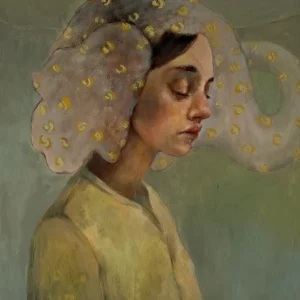


Beskrivning
Digital
50 x 70 cm
Happy Days are Here Again
There are moments when art, history, and the cosmos converge in an image that seems to embody something greater than itself. One such image is ”Happy Days Are Here Again,” where Marilyn Monroes presence is transformed from the Hollywood stage into the limitless theatre of space. She becomes not only a symbol of glamour and fleetingness but also of humanitys eternal yearning for light in the darkness. In this essay, I aim to engage the reader in a journey through the various layers of interpretationfrom the personal and poetic to the scientific and mythicalto explore the enigmatic and beautiful phenomenon that is the Marilyn Nebula.
Join me as we pass through the gateway of this essay to explore Marilyn Monroes luminous dance, deeply intertwined with themes of stardom, memory, and eternal light. This essay is not just a text, but a welcoming gateway designed to entertain and illuminate the symbolic connection between an earthly icon and her cosmic rebirth. We will examine the historical echoes and the profound cultural imprint her image has left over time, offering a deeper understanding of this timeless wonder and its role in conveying hope, longing, and the fragile brilliance of human dreams.
Marilyn in the Nebula
She lifts her glass,
a shimmer against the void,
two torches blazing
where silence folds the stars.
Her dress, a river of sequins,
flows forty light-years long,
each ruby, each diamond
a heartbeat of forgotten applause.
She dances where galaxies gather,
her song a refrain reborn,
Happy Days Are Here Again
woven into the breath of dust and fire.
No curtain falls in this theatre,
no spotlight dims her glow;
she is Stardust remembering itself,
a dream returned as light.
And in the hush of Öresund,
the water black and endless,
I heard her whisper
not madness, but music:
that even in the dark,
we may dance.
Malmö. September 2025
Happy Days are Here AgainAutumn and the Discovery of the Marilyn Nebula
This autumn has not only hosted a full red moon, but darkness has revealed something even greater: a newly discovered nebula. Through a powerful telescope, Marilyn Monroe appeared to be dancing beyond the Andromeda Galaxy, in a haze I swiftly named the Marilyn Nebula. This nebula, with its swirling, radiant beauty, seemed to embody the spirit of Marilyn, a woman who was herself a celestial phenomenon. She was as luminous as daylight in the deepest night, and she dancedthe distant shimmer moved, shifted shape clearly, and after a while, I could set tones to its rhythm, hundreds of light years away. The distance was far too great to hear the music, no matter how I strained my ears, but inside me, the song grew. She sang and danced to Happy Days Are Here Again, a hit from 1929. It is undeniably infectious, and I felt it in my legs. Luckily, I was alone as I stood by the shores of Öresund; otherwise, people would have thought me not only eccentric but also completely mad. I hummed along with Marilyns inner voice, as delightful as it once was on earth.
It was not only the music that brought Marilyns days on earth to mind, but also the long red sequined dress she woresurely forty light years in length from head to toe. All of Marilyn sparkled in harmony with the gown, decorated across her body with diamonds, pearls, emeralds, rubies, and every precious stone conceivable, gleaming above.
Happy Days Are Here Again and the Cosmic Dance of Nebulae
”Happiness Is a Thing Called Joe” is not a song; however, ”Happy Days Are Here Again” originally comes from the film ”Chasing Rainbows,” released in 1920. However, in Marilyns version, she was not chasing rainbows but stars and galaxies. For that is how nebulae functionthey are the womb of the cosmos, the chamber of eternity where new stars and planets are born. She moved in harmony with these cosmic rhythms, and indeed this celestial haze danced across the heavens that September night.
The nebulas body is matter in motion, an organism of light-years expanding at speeds of up to 800 kilometres per second. Material closer to a central star moves more slowly, creating layers, rhythms, and strata, as if the universe itself were composing music. Their form evolves through rotation and expulsions of dust and gas, seemingly shifting forever. Just as breath forms clouds on a cold winters day, so Marilyns breathing shaped her own patterns, her own cosmic mist, within that captivating dance.
Many nebulae are expanding clouds, endlessly stretching the boundaries of infinity. Some of these outflows move at astonishing speeds, yet they remain both cradle and sanctuary for newborn stars and solar systems. Within these celestial nurseries, stars reshape the surrounding gas and dust, blowing out long shadows and filaments that cut through space, forming new shapes and silhouettes. Everything is in constant motion, yet the whole is a danceand in that dance, Marilyn found her eternal role.
It is no surprise, then, that she now dances there. The very dynamics of the nebulathe expansion of gas, the curling strands of dust, the storming winds of newborn starsbecame her orchestra. No wonder the song was reborn in me, as I stood by the Öresund. It was a cosmic concert, an eternal performance, and at its centre stood she: Marilyn, hovering among glowing dust and dazzling light, her voice turning darkness into music.
Marilyn as a Timeless Icon
Marilyn, a timeless icon, has transcended her role as a symbol of Hollywoods seductive glamour. In her celestial rebirth, she gains new, awe-inspiring significance. No longer merely a film star, she now exists as part of the cosmos, an eternal cradle of creation. She embodies both myth and matter, memory and renewal, her dance transforming the dark void into a shimmering stage, inspiring awe and amazement in those who witness her cosmic significance.
Her two champagne glasses become, in this cosmic tableau, double symbols: of celebration and excess, but also of balance and strength. They shine as if they were two torches, as though she were carrying light in each handa light that will not fade but continues to stream through the galaxies. These glasses, symbols of earthly indulgence, now take on a cosmic significance, representing the balance and strength that Marilyn found in her eternal role. It is a cosmic toast, a gesture extended to us on Earth.
The title Happy Days Are Here Again embodies this very ambiguity. It is filled with optimism after dark times, yet beneath it lies an undertone of ironyfor which days are joyful, and for whom? Marilyns own life swung like a pendulum between extremes: laughter and tears, triumph and loneliness, light and shadow. In the end, the darkness prevailed, but in eternity, she has found peace and now spreads her light into the nights of others.
In this celestial image, one can trace the lines of art and cultural history across time. From the Great Depression of the 1930s, when ’Happy Days Are Here Again’ first became popular as a hymn of hope and survival, to Marilyns own era, when she stood as a symbol of postwar longing for dreams and glamour. And now, in our own age, where hope and anxiety are intertwined just as inseparably, her image still speaks to usboth as a promise and as a warning, linking us to our past and urging us to reflect on our present, fostering a sense of connection and reflection in the audience.
Art Historical and Cultural Connections
Seeing Marilyn dance in space means travelling through multiple layers of art and cultural history at once. Her figure becomes a reflection of all the eras that have carried her: the 1930s ”Happy Days Are Here Again,” a song that first emerged from the shadows of the Depression as a beacon of light in darkness, is here reborn as a cosmic refrain. She no longer performs it on a Hollywood stage, but in the universes own theatre, where nebula gas clouds serve as curtains and star birth explosions function as spotlights.
She thus unites different layers of time. In the 1950s, she personified the postwar desire for glamour and escape, along with its delicate façade, while the anxieties of the Cold War always loomed in the background. In our current era, as global crises emerge one after another and hope feels as elusive as a fleeting star, she serves as a reminder of both the power of dreams and their vulnerability.
In art history, she can be compared to the Renaissance Madonnas, who also conveyed light and hope through dark times. However, where the Madonna held the child as the worlds salvation, Marilyn lifts her champagne glassesnot as a child, but as two symbols of adult vitality, decadence, and survival in one. She becomes a pop-cultural saint, a secular Madonna whose iconography is just as powerful as that of the classical paintings.
She can also be seen through the lens of surrealism: a woman transported from Earth into the realm of the impossible, amidst cosmic darkness, in a pose that is part dream, part hallucination. Just as Dalí or Magritte could place everyday objects in cosmic settings, Marilyn is placed here in a universe that redefines her image. Yet where surrealism often drifted toward the absurd, her presence offers a sense of comfort.
In popular culture, she is immortalfrom Warhols silkscreens to countless imitations in fashion and advertising. But here she takes a step beyond earth. In the nebula, she becomes an eternal projection, an icon of humanitys need to create meaning, to carry the light of our icons far beyond the Earth’s horizon. She becomes a symbol of our desire to dance, sing, and hope, even in the outermost darkness of space.
Science and Myth in Interplay
When observing a nebula through a telescope, one does not see merely dust and gas. Instead, one perceives movement, change, and processes unfolding over billions of years. The nebula serves both as a scientific phenomenon and a myth: a physical event, yet also a spiritual landscape onto which we project our dreams. There is no contradiction here, only a mutual dependence. Astronomers can measure velocities, chemical compositions, and energy flowsbut people like me can also see Marilyn there, dancing, a figure who infuses the data of science with human meaning.
A nebula is made up of hydrogen and helium, but also contains heavier elements such as iron, carbon, and nitrogenthe very elements that form our bodies. It embodies the cycle of stardust. When we see Marilyn floating in the nebula, we can quite literally say she is composed of the same matter. Her body, once alive on Earth, was also made of stardust. In her return to space, myth and science intertwine: physical reality and cultural imagination are two sides of the same coin.
Science describes the nebula’s expansion at 800 kilometres per second, accompanied by constant eruptions and the expulsion of dust in spirals. But within this, there is also poetry. It is nothing less than the dance of the cosmosa rhythmic motion that calls to mind the human body in movement. When I saw Marilyn out there, it was as if the formulas of science momentarily turned into music. What are usually numbers and spectral lines became melody and song.
And perhaps it is precisely this that makes the meeting of myth and science so powerful. Astronomy explains how nebulae form, how stars are born, and how they die. But our imagination gives them life, transforming them into stages where we can once again meet our icons. Marilyn becomes the goddess of the nebula, not because the telescope reveals her, but because our longing for meaning places her there. In this union of physics and fantasy, we find a more profound sense of truth: that the universe is not only matter, but also story.
Epilogue
When I finally lowered the telescope and returned my gaze to the dark waters of the Öresund, the image stayed with me. Marilyn was still dancing out there, in a movement unhaltable by either time or distance. She was both and infinitely distant, a constellation within my own inner sky.
On Earth, her life has long since ended, but in space, she continues to radiate light. She is a reminder that our icons never truly diethey are reshaped, they grow into new images, new stories. The transformative power of memories and myths in keeping our icons alive and shining is a source of inspiration and hope for us humans, showing us that our legacies can endure long after our bodies are gone.
Happy Days Are Here Again echoes like a refrain, both joyful and sorrowful. It is a song of hope, yet also of loss a melody that reminds us that happy days are always fragile. Marilyn now carries it in the arms of space, as if she wishes to send the message back to us: that we must dare to dance, dare to believe in the light, even when the darkness surrounds us. Her cosmic dance is a powerful symbol of resilience and hope, uplifting us and reminding us to hold onto the light.
And perhaps it is precisely this that makes her figure eternal. She is no longer merely Hollywoods star, no longer just an icon on posters and silver screens. She is part of the cosmos itself, a voice in the choir of the universe, a reminder that even in the depths of darkness something can shimmer, sing, dance. Her eternal presence in the cosmos invokes a sense of awe and wonder, reminding us of the timeless power of our icons.
When I think back to that night by the Öresund, I know I was not mad. I was just humana being who sees stars, hears songs, and needs its icons to survive. And somewhere out there, Marilyn is still dancing, in her sequined haze, whispering to us: Happy Days Are Here Again.